
 A:对空攻击
 B:对地攻击
街机
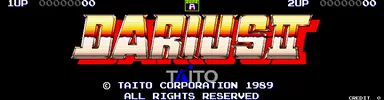
大流士战机 II (triple screen) (日版)
街机 · CPS1
选择一款游戏后开始
支持 EmulatorJS 云端核心、键位方案、本地 ROM 与浏览器存档。
大流士战机 II (triple screen) (日版) 游戏介绍
查看游戏资料、发行信息与玩法介绍。
- 名称
- 大流士战机 II (triple screen) (日版)
- 英文名
- Darius II (triple screen) (Japan)
- 公司
- Taito Corporation
- 年份
- 1989
- 平台
- Arcade
- 人数
- 2 人
- 操作
- P1 joy 8向 2键 · P2 joy 8向 2键
- 系列
- Darius
查看游戏简介全文
《大流士战机 II (triple screen) (日版)》是 Taito Corporation 于 1989 年推出的街机游戏。本站提供浏览器在线游玩,并收录操作、角色与玩法资料。
故事背景与历史价值Story background and historical notes
资料库未提供中文记录,以下保留英文原始资料。
A 29-year-old Arcade Video Game PCB
Darius II (c) 1989 Taito.
The direct sequel to the 1986 original, Darius II retained the distinctive 3-screen format of the first game.
The power-up system of Darius II was changed from that of its parent game, with players having to destroy complete waves of a particular enemy to earn a power-up. 2 new power-ups were also added; the 1st was a new weapon power-up that gave the player green, vertical lasers, the 2nd power-up was a rainbow-colored item that powered up all of the players weapons.
Another new feature of Darius II is the appearance of mini-bosses - large enemies that appear at the mid point of a level, possessing similar strength and abilities to those of the game's normal bosses (such as extravagant weapons, or the inability to be damaged without first exposing a vulnerable area). The mini-bosses in Darius II are in fact smaller versions of the bosses from Darius.
The game is set in the inner regions of the Solar system, and has the same branching level structure as Darius, allowing players to select their own route through the game.
- TECHNICAL -
Prom Stickers : C07
Main CPU : (2x) Motorola 68000 Sound CPU : Zilog Z80 Sound Chips : Yamaha YM2610, (4x) Volume
Players : 2 Control : 8-way joystick Buttons : 3
- TRIVIA -
Darius II was released in September 1989.
This game is known in US as "Sagaia" (licensed to Romstar for distribution).
Two versions of this game were made : The more common three-screen version (like the original "Darius"), and a harder to find two-screen version (aspect ratio : 8/3)
Pony Canyon / Scitron released a limited-edition soundtrack album for this game (Darius II : G.S.M. Taito 4 - PCCB-00010-12) on November 21, 1989.
Zuntata Records released a limited-edition soundtrack album for this game (Zuntata History L'ab-normal 1st - ZTTL-0038) on April 1, 1999.
- SERIES -
1. Darius (1987, Arcade) 2. Darius II (1989, Arcade) 3. Darius Twin [Model SHVC-DT] (1991, Super Famicom) 4. Darius Force [Model SHVC-DH] (1993, Super Famicom) 5. Darius Gaiden - Silver Hawk (1994, Arcade) 6. G-Darius (1997, Arcade) 7. G-Darius ver.2 (1997, Arcade) 8. Darius Burst (2009, Sony PSP) 9. Darius Burst - Another Chronicle (2010, Arcade) 10. Darius Burst - Another Chronicle EX (2011, Arcade)
- STAFF -
Directed and produced by : Hidehiro Fujiwara Game designed by : Hidehiro Fujiwara, Senba Takatsuna Programmed by : Akira Ohtsuki, Tatsuo Nakamura, Masashi Tsuzura, Shinji Soyano Art designed by : Masami Kikuchi, Senba Takatsuna, Hisakazu Kato Cabinet designer : Yoshinori Aiura Hardware designed by : Toshiyuki Sanada All music composed and arranged by : Hisayoshi Ogura (Team Zuntata) Sound editors : Yasuhisa Watanabe, Norihiro Furukawa Sound software : Naoto Yagishita
- PORTS -
* CONSOLES: [JP] Sega Mega Drive (dec.20, 1990) "Darius II [Model T-11083]" [JP] NEC PC-Engine CD (dec.24, 1993) "Super Darius II [Model NAPR-1031]" [JP] Sega Saturn (june.7, 1996) "Darius II [Model T-1104G]" [JP] Sony PS2 (jan.25, 2007) "Taito Memories II Joukan [Model SLPM-66649]"
* HANDHELDS: Nintendo Game Boy [AS] (1991) "Sagaia [Model DMG-116 CHN]" [JP] Nintendo Game Boy (dec.13, 1991) "Sagaia [DMG-S8A]"
- CONTRIBUTE -
Edit this entry: https://www.arcade-history.com/?&page=detail&id=587&o=2
A 29-year-old Arcade Video Game PCB
Darius II (c) 1989 Taito.
The direct sequel to the 1986 original, Darius II retained the distinctive 3-screen format of the first game.
The power-up system of Darius II was changed from that of its parent game, with players having to destroy complete waves of a particular enemy to earn a power-up. 2 new power-ups were also added; the 1st was a new weapon power-up that gave the player green, vertical lasers, the 2nd power-up was a rainbow-colored item that powered up all of the players weapons.
Another new feature of Darius II is the appearance of mini-bosses - large enemies that appear at the mid point of a level, possessing similar strength and abilities to those of the game's normal bosses (such as extravagant weapons, or the inability to be damaged without first exposing a vulnerable area). The mini-bosses in Darius II are in fact smaller versions of the bosses from Darius.
The game is set in the inner regions of the Solar system, and has the same branching level structure as Darius, allowing players to select their own route through the game.
- TECHNICAL -
Prom Stickers : C07
Main CPU : (2x) Motorola 68000 Sound CPU : Zilog Z80 Sound Chips : Yamaha YM2610, (4x) Volume
Players : 2 Control : 8-way joystick Buttons : 3
- TRIVIA -
Darius II was released in September 1989.
This game is known in US as "Sagaia" (licensed to Romstar for distribution).
Two versions of this game were made : The more common three-screen version (like the original "Darius"), and a harder to find two-screen version (aspect ratio : 8/3)
Pony Canyon / Scitron released a limited-edition soundtrack album for this game (Darius II : G.S.M. Taito 4 - PCCB-00010-12) on November 21, 1989.
Zuntata Records released a limited-edition soundtrack album for this game (Zuntata History L'ab-normal 1st - ZTTL-0038) on April 1, 1999.
- SERIES -
1. Darius (1987, Arcade) 2. Darius II (1989, Arcade) 3. Darius Twin [Model SHVC-DT] (1991, Super Famicom) 4. Darius Force [Model SHVC-DH] (1993, Super Famicom) 5. Darius Gaiden - Silver Hawk (1994, Arcade) 6. G-Darius (1997, Arcade) 7. G-Darius ver.2 (1997, Arcade) 8. Darius Burst (2009, Sony PSP) 9. Darius Burst - Another Chronicle (2010, Arcade) 10. Darius Burst - Another Chronicle EX (2011, Arcade)
- STAFF -
Directed and produced by : Hidehiro Fujiwara Game designed by : Hidehiro Fujiwara, Senba Takatsuna Programmed by : Akira Ohtsuki, Tatsuo Nakamura, Masashi Tsuzura, Shinji Soyano Art designed by : Masami Kikuchi, Senba Takatsuna, Hisakazu Kato Cabinet designer : Yoshinori Aiura Hardware designed by : Toshiyuki Sanada All music composed and arranged by : Hisayoshi Ogura (Team Zuntata) Sound editors : Yasuhisa Watanabe, Norihiro Furukawa Sound software : Naoto Yagishita
- PORTS -
* CONSOLES: [JP] Sega Mega Drive (dec.20, 1990) "Darius II [Model T-11083]" [JP] NEC PC-Engine CD (dec.24, 1993) "Super Darius II [Model NAPR-1031]" [JP] Sega Saturn (june.7, 1996) "Darius II [Model T-1104G]" [JP] Sony PS2 (jan.25, 2007) "Taito Memories II Joukan [Model SLPM-66649]"
* HANDHELDS: Nintendo Game Boy [AS] (1991) "Sagaia [Model DMG-116 CHN]" [JP] Nintendo Game Boy (dec.13, 1991) "Sagaia [DMG-S8A]"
- CONTRIBUTE -
Edit this entry: https://www.arcade-history.com/?&page=detail&id=587&o=2
大流士战机 II (triple screen) (日版):操作、角色与玩法资料Darius II (triple screen) (Japan): controls, characters and gameplay notes
 4
4 64 / 6 为后 / 前方向(随角色朝向理解)
 2
2 82 / 8 为下 / 上方向AB
 C为街机功能键,不等同于浏览器键位
1基本操作展开查看
2关于自机展开查看
[导弹(红)](0-1-2-3-4-5-6-7)
[激光(黄)](0-1-2-3-4-5-6-7)
[炸弹(绿)](0-1-2-3-4-5-6-7)
[防御罩(蓝)]
·Lv1防御罩 [耐久力3/+1](0-1-2-3)
→Lv2强力防御罩 [耐久力3/+2](4-5-6-7)
→Lv3超级防御罩 [耐久力3/+2](8- )
3选择关卡展开查看
1)重置游戏的时候按住"业务用开关"键(默认是9),
直到屏幕显示SERVICE SW ERROR
2)输入1PS(3次),"业务用开关"键,1PS,
就会进入关卡选择界面