
Game ID : GX068
Main CPU : Motorola 68000 (@ 12 Mhz)
Sound CPU : Zilog Z80 (@ 8 Mhz)
Sound Chips : Yamaha YM2151 (@ 4 Mhz), K053260 (@ 4 Mhz)
Players : 2
Control : 8-way joystick
Buttons : 2
Classic games, ready to play.
街机 · FBNEO
支持 EmulatorJS 云端核心、键位方案、本地 ROM 与浏览器存档。
A 26-year-old Arcade Video Game PCB
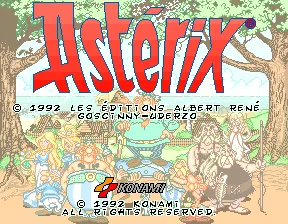
Astérix (c) 1992 Konami Company, Limited.
Asterix is a horizontally-scrolling beat-em-up for one or two players and is based on the French comic-book series, 'Asterix & Obelix'. Players fight as either Asterix the Gaul or his best friend, Obelix, as they take on the might of the oppressive Roman Empire.
Asterix and Obelix each have standard jump/attack controls, as well as a dash attack activated by tapping the joystick forward twice then pressing the attack button. Each character also posesses a powerful spinning arm attack, this is activated by holding the attack button for a short while until the character's face turns red, after which players must release the button. If the button is held down for too long, the character gets out of breath and takes a few seconds to recover.
The heroes' main foes are Roman legionaries and fat - ocassionally horseback riding - centurions. After an enemy has been beaten enough to fall to the ground, he can be picked up and attacked again, the nature of the attack is dependant on which character picks them up; Asterix will spin the stunned enemy above his head, whereas Obelix smashes him repeatedly into the ground. These stunned enemies also act as tempoarary weapons, as they will cause damage to any other enemies they come into contact with.
Ocassionally, a beautiful blonde lady called Panacea appears carrying a basket. If Asterix or Obelix walk up to her, she will give them a kiss, restoring some health and temporarily paralysing any on-screen legionaries with embarrassment. Health can also be replenished by picking up the piles of red apples that litter the stages.
Asterix features eight different stages, called 'acts', all with a boss fight at the end. Every act from the second one onwards is based on a different book from the Asterix series and contains signature locations, objects and themed enemies, including pirates, thieves and Indian guards.
Bonus levels appear after certain stages, featuring either a timed chariot race, or a timed barrel-smashing sequence on board a sailing ship. The game's eight different stages are:
* First Act: Village
* Act 2: Asterix in Egypt
* Act 3: Asterix in Britain
* Act 4: Asterix and the Admirable Panacea
* Act 5: Asterix in Spain
* Act 6: Asterix and the Magic Carpet
* Act 7: Asterix Vs Caesar
Game ID : GX068
Main CPU : Motorola 68000 (@ 12 Mhz)
Sound CPU : Zilog Z80 (@ 8 Mhz)
Sound Chips : Yamaha YM2151 (@ 4 Mhz), K053260 (@ 4 Mhz)
Players : 2
Control : 8-way joystick
Buttons : 2
Asterix was released in May 1992.
The rock that Obelix carries on his back is called a menhir. It was used in many ancient religious rituals in places like Carnac in the French province of Brittany, particularly during the time of 2000 to 1500 B.C.
King Records released a limited-edition soundtrack album for this game (Konami Game Music Collection Vol.5 - KICA-7605) on September 26, 1992.
* Tip : When playing as Obelix, the character starts each stage carrying his big rock. Try to hit as many Romans as possible before Obelix throws it away. Any Romans driven away with the rock will drop their helmets on the ground, these can be picked up by the player to earn bonus points.
* Drinking the magic potion (Asterix) or eating a roast (Obelix) will make the respective character invincible for several seconds, allowing them to plow through the Romans, causing the embarrassed Legionnaires to drop their helmets before running away.
Main programmer : Narunopapa
Sub programmer : Yuko Itoh
Graphic director : M. Kukino
Background designer : S. Wada
Enemy designer : T. Akiyama
Sound effect : J-Kane
Sound programmer : Panda
Music composer : Mutsuhiko Izumi, M. Egama, Michiru Yamane (Chiru Chiru), J. Nakano, A. Hashimoto
Hard designer : Hideto Murata
Art Works : Naoko Sato
Edit this entry: https://www.arcade-history.com/?&page=detail&id=124&o=2