
 A升级武器
A升级武器  B主火力
B主火力  C对地武器/铃铛武器
选择AUTO操作模式时,系统自动选择并升级专案。
选择MANUAL操作模式时,可以手动细化决定升级专案
。若不想执行当前项目,再吃一个红胶囊即可将选择
框移至下一个。
画面下方的专案表:
SPEED UP栏是速度
2-5栏是基本武器
!?是选择框在速度、基本武器和防护罩之间快速移动
SHIELD是防护罩 (AUTO模式无此专案)
空白栏是显示当前铃铛武器(炸弹、KIKU光束)
顶蘑菇 启动!
街机 · CPS1
支持 EmulatorJS 云端核心、键位方案、本地 ROM 与浏览器存档。
查看游戏资料、发行信息与玩法介绍。
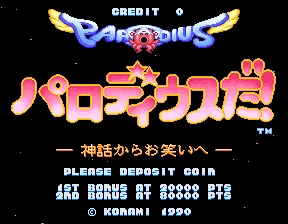
Q版沙罗曼蛇英文叫Parodius Da!,Parodius就是来源于Parody + “Gradius”。 实际上,这个游戏是宇宙巡航机的一个KUSO版,尽管是由同一帮人开发的。但国内由于沙罗曼蛇的影响力比较大,所以进口商都叫它沙罗曼蛇了。
Q版沙罗曼蛇 1990 KONAMI
Q版沙罗曼蛇英文叫Parodius Da!,Parodius就是来源于Parody + “Gradius”。 实际上,这个游戏是宇宙巡航机的一个KUSO版,尽管是由同一帮人开发的。但国内由于沙罗曼蛇的影响力比较大,所以进口商都叫它沙罗曼蛇了。
“Q版沙罗曼蛇系列”最初出现在MSX上。由于MSX的机能实在是很有限,出来的效果比较一般。KONAMI又将这个实验性的作品进一步改良放到街机平台上。这次画面当然有大幅度的提高,同时搞笑程度也高很多。
游戏系统类似宇宙巡航机系列,可以吃到道具提高自身战机(?)的能力。敌人则是极尽搞笑之能,不少角色其实是KONAMI其它游戏作品的角色。
A 28-year-old Arcade Video Game PCB
Parodius Da! Shinwa kara Owarai e (c) 1990 Konami.
Parodius Da! is a horizontally-scrolling shoot-em-up in which the Great Octopus has threatened Earth. To help Parodius save the planet, the player and his friends must begin their search across the world to find the enemy and destroy him.
Parodius Da! was created as a parody of Konami's own "Gradius" series of shoot-em-ups but adopted a graphical style that was entirely its own; something that becomes evident at the very start of the game when players can chose to pilot either a penguin or an octopus rather that the traditional Gradius ship.
Parodius retains the selectable weapons system of "Gradius"; a 'power meter' at the bottom of the screen enables players to 'buy' weapons and upgrades using capsules left behind by certain destroyed enemies. Each collected capsule advances the power meter by one step. Players can activate the highlighted item at any point, after which the power meter resets. For this game, players can also choose to have weapons update automatically, with the game upgrading weapons simply by collecting the capsules.
Parodius Da! also allows players to pilot any one of four different characters: Vic Viper (from Gradius/Nemesis), Octopus, TwinBee and Pentarou. Another new addition is that of bell power-ups. These originally appeared in Konami's "TwinBee" series and act as one-time power-ups, allowing the player to destroy every enemy on screen, for example, or fire huge energy beams.
Enemies and environments from the Gradius games and TwinBee are mixed in along with a host of anime-style opponents, including scantily-clad women. Parodius' eccentricity and unique humour is further demonstrated soon after the game begins; as players face such enemies as a giant belly-dancing woman and a half-cat/half-boat creature.
- TECHNICAL -
Konami TMNT2 Hardware Game ID : GX955
Main CPU : KONAMI Sound CPU : Zilog Z80 Sound Chips : Yamaha YM2151, K053260
Players : 2 Control : 8-way joystick Buttons : 3
- TRIVIA -
Released in April 1990.
The title of this game is a combination of two words : Parody + "Gradius" = Parodius. The subtitle of this game translates from Japanese as 'From Myth to Joke', which is a homage to the "Gradius III" subtitle : 'From Legend to Myth'.
During the game's attract mode, potential players are presented with a short history tour of the Nemesis series, as the title screen of each of Parodius's prequels are introduced'; watched, in typical Parodius style, by a crowd of blue and pink penguins.
Pentarou is from the MSX game "Antarctic Adventure". The second boss (Patrotic Eagle) is similar to the first boss of "Gradius 2" (phoenix). This boss is often coined as a reason why Parodius was never released in the U.S. The Vegas dancer near the end of the second stage is similar to the robot spider near the end of "Gradius 2". She appears in other Parodius games as well.
Stage 1 crucial part music is a remix of 'Symphony No.9 4th Movement', by Beethoven. Stage 1 boss music is a remix of 'The Flight of the Bumble Bee', by R. Korsakov. Stage 2-1 music is a remix of 'Op.71a the Nutcracker', by P. Tchaikovsky. Stage 2-2 music is a remix of the music from "Gradius III". Stage 2 boss music is a remix of the music from "Gradius II". Stage 3 music is a megamix of 'Op.71a the Nutcracker', by P. Tchaikovsky. And 'Overture to William Tell', by G. Rossini. Stage 3 boss music is a remix of 'Orphée aux enfers', by J. Offenbach. Stage 4 music is a remix of 'Danse du sabre', by A.I. Khachaturyan. Stage 5 music is a remix of 'L'Arisienne suite No.2', by G. Bizet. Stage 6 music is a remix of 'from Gunkan March', by Japanese Martial Song. Stage 6 boss music is a remix of the music from "Gradius". Stage 7 music is a remix of 'Op.71a the Nutcracker Valse des Fleurs', by P. Tchaikovsky. Stage 8 music is a megamix of 'Violine Konzert e moll', by F. Mendelssohn. And 'Unter dem Doppeladler', by J. F. Wagner. Stage 9 music is a megamix of 'Peer Gynt Suite', by E. Grieg. And 'Swan Lake', by P. Tchaikovsky. Stage 9 boss music is a remix of 'William Tell Overture', by G. Rossini. Stage 10 and Stage 10 boss music are remix of music from "Gradius".
King Records released a limited-edition soundtrack album for this game (Parodius Da! Original Game Soundtrack - KICA-1011) on 21/07/1990.
- SERIES -
1. Parodius - Tako wa Chikyuu o Sukuu [Model RC759] (1988, MSX) 2. Parodius Da! Shinwa kara Owarai e [Model GX955] (1990, ARC) 3. Gokujyou Parodius! Kako no Eikou wo Motomete [Model GX321] (1994, ARC) 4. Jikkyou Oshaberi Parodius [Model SHVC-AJOJ-JPN] (1995, SFC) 5. Sexy Parodius (1996, ARC)
- STAFF -
Main programmers : Chichibinta, Tsukasa Sub-programmer : Tyuken Character designers : GaKincho, Touyou Syoutarou, Takemasa.M, Mory-Wandyu, Mikachan Sound : -Cameo- Matano, -Dokuo- Umeno Hard designer : Dendou Konishi Tool designers : Au Toshimi, Kanton Ten
- PORTS -
* CONSOLES: Nintendo Game Boy (1991) NEC PC-Engine (1992) [JP] Nintendo Famicom (1992) [JP] Nintendo Super Famicom (1992) "Parodius Non-Sense Fantasy" Sony PlayStation (1994) "Parodius Deluxe Pack" Sega Saturn (1995) "Parodius Deluxe" [JP] Sony PSP (Jan. 25, 2007) "Parodius Portable [Model ULJM-05220]" [JP] Sony PSP (Mar. 13, 2008) "Parodius Portable [Konami the Best] [Model ULJM-05324]"
* COMPUTERS: [JP] Sharp X68000 (1991)
- CONTRIBUTE -
Edit this entry: https://www.arcade-history.com/?&page=detail&id=1937&o=2
 4
4 64 / 6 为后 / 前方向(随角色朝向理解)
 2
2 82 / 8 为下 / 上方向ABC为街机功能键,不等同于浏览器键位
A升级武器 B主火力 C对地武器/铃铛武器
选择AUTO操作模式时,系统自动选择并升级专案。
选择MANUAL操作模式时,可以手动细化决定升级专案
。若不想执行当前项目,再吃一个红胶囊即可将选择
框移至下一个。
画面下方的专案表:
SPEED UP栏是速度
2-5栏是基本武器
!?是选择框在速度、基本武器和防护罩之间快速移动
SHIELD是防护罩 (AUTO模式无此专案)
空白栏是显示当前铃铛武器(炸弹、KIKU光束)
包含有两个变数:rank值、武器计数。
游戏开始时,机台设置的游戏难度决定了初始的
rank值:
容易 - 0
普通 - 2
困难 - 4
极难 - 6
武器计数在游戏中始终在增加。增加的速率取决于
当前火力状态以及有什么铃铛。
直接影响rank值的因素:
过关:+1
辅助火力:每个+1。
死命或启动!?失去辅助火力时,每个-1。
护盾:启动时+1
蓝铃铛:得到+1,使用-1。
死命时,根据拥有的数量,每个-1。
红铃铛:得到+1,使用-1。
死命时,根据拥有的数量,每个-1。
死命:大多数时-2。
BOSS战时死命-1,然后进入下一关时再-2。
直接影响武器计数的因素:
启动加速
启动护盾
得到绿铃铛
得到白铃铛
最后一关的特殊Rank系统规则:
进入关卡后,rank值+2
不管是否有辅助火力,rank值+4
得到绿铃铛,rank值+2
得到白铃铛,rank值+2
得到红铃铛,rank值+1;启动,+2
红胶囊 - 升级底部的武器
蓝胶囊 - 杀死当前画面上的小型敌人
铃铛(铃铛受攻击会变色):
黄铃铛 - 500分,持续吃能得高分。
(第2个1000分,然后依次是2500,5000,
最高是10000分!)
蓝铃铛 - 炸弹. 最多能有3个.
红铃铛 - KIKU光束.
射出一段纵向镭射保护你不受敌人和子弹伤害。
绿铃铛 - 机体变大且短时无敌,
该状态下再吃铃铛无效。
白铃铛 - 用小喇叭喊话。字体有攻击力。
Stage 1 部分音乐来自德国作曲家贝多芬的
《第九号交响曲第四乐章 - 欢乐颂》
Stage 1 BOSS战的音乐是俄罗斯作曲家
里姆斯基·柯萨科夫的《野蜂飞舞》
Stage 2-1 音乐是俄国作曲家柴可夫斯基的
《Op.71A 胡桃夹子组曲》
Stage 2-2 音乐来自《太空战斗机 III》
Stage 2 BOSS战音乐来自《太空战斗机 II》
Stage 3 音乐是俄国作曲家柴可夫斯基的
《Op.71A 胡桃夹子组曲》和意大利作曲家罗西尼的
《威廉退尔序曲》
Stage 3 BOSS战音乐是德国作曲家奥芬巴赫的
《地狱中的奥菲欧》
Stage 4 音乐是亚美尼亚作曲家哈恰图良的
《马刀舞曲》
Stage 5 音乐是法国作曲家比才的
《阿莱城姑娘 管弦组曲第2号》
Stage 6 音乐是日本军事歌曲《军舰进行曲》
Stage 6 BOSS战音乐来自《太空战斗机》
Stage 7 音乐是俄国作曲家柴可夫斯基的
《Op.71a 胡桃夹子组曲-花之圆舞曲》
Stage 8 音乐是德国作曲家孟德尔松的
《E小调小提琴协奏曲》和
德国作曲家瓦格纳的《双鹰旗下进行曲》
Stage 9 音乐是挪威作曲家格里格的
《皮尔·金特 组曲》和
俄国作曲家柴可夫斯基的《天鹅湖》
Stage 9 BOSS战音乐是意大利作曲家罗西尼的
《威廉退尔序曲》
Stage 10 和 BOSS战音乐来自《太空战斗机》